Fixed Right First Time:A Basic Expectation When Unmet Destroys Loyalty—and Capacity
At ROAR, our team members have been monitoring Fixed Right First Time (FRFT) performance since the early 1990s. This was long before “CX” became the buzzword it is today.
Back then, average FRFT rates across automotive clients sat in the mid 70% range, meaning one in four vehicles had to return for a repeat repair. Over the decades, as technician training, diagnostics, and parts logistics improved. As a result, FRFT rates have risen dramatically, even as vehicle complexity increased.
Today, many dealer networks consistently operate in the 90% range — a remarkable achievement reflecting years of progress and investment in process, people, and technology. But that success story comes with an important caveat: even 10–15% of workshop capacity consumed by rework is still too much.
- The New Challenge: Capacity Under Pressure
- Why Appointments and Pre-Diagnosis Are Critical
- How ROAR Helps Eliminate the Guesswork
- From Repair to Relationship
- Takeaway
The New Challenge: Capacity Under Pressure
Industry consolidation has reshaped dealership networks:
With fewer workshops serving larger carparks, efficiency pressures have never been higher.
When even a small fraction of capacity is lost to repeat repairs, the impact ripples through the system. Customer wait times increase, profitability declines, and throughput for higher value customer-pay jobs is reduced.
In this new environment, “good enough” isn’t good enough.
A 90% Fixed Right First Time (FRFT) rate might sound impressive, but if 10% of jobs return, that can represent thousands of hours in lost productivity and significant profit erosion across a network. And this doesn’t take into consideration the 1-5% of multiple return issues.
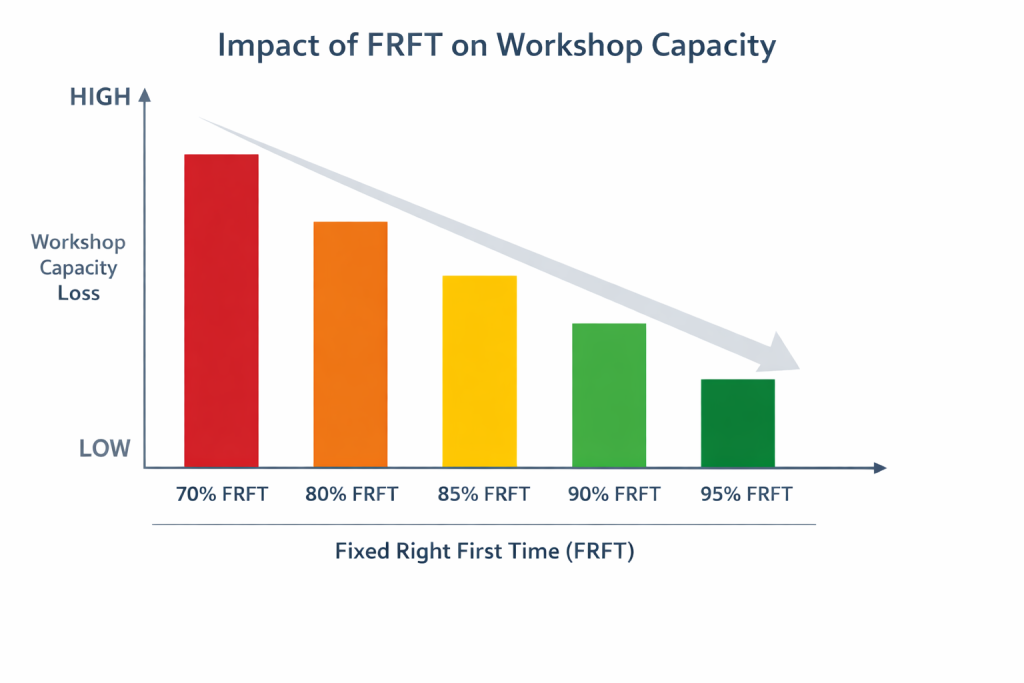
Fixed Right First Time (FRFT) impact on workshop capacity.
Even at 90% FRFT, repeat repairs continue to consume meaningful workshop capacity.
Why Appointments and Pre-Diagnosis Are Critical
Despite the progress made, one factor still ranks among the top reasons vehicles aren’t fixed right the first time: parts unavailability.
In many cases, this isn’t a supply chain problem — it’s an information one.
Too often, workshops only discover what’s needed after the vehicle arrives.
This reactive model wastes valuable technician time and undermines customer confidence. Even with 1x or 2x daily parts deliveries, identifying the part needed and getting it delivered must still provide enough time for the techs to fix it, check it, clean it.
The solution lies in structured appointments and intelligent pre-diagnosis. By collecting meaningful information before the visit, workshops can forecast likely parts and allocate the right technician skillsets in advance.
ROAR’s data shows that service centers implementing robust pre-diagnosis processes — whether through digital forms, advisor follow-ups, or AI-driven symptom capture — experience significantly higher first-time fix rates and lower overall repair cycle times.
How ROAR Helps Eliminate the Guesswork
ROAR’s Service ROARBOTS were designed to address exactly this issue.
By integrating appointment data, pre-diagnosis inputs, and CX feedback, ROARBOTS gives service teams a predictive view of the work ahead.
Using AI and pattern recognition, the system can:
- Flag jobs at risk of repeat repair based on historical symptom patterns.
- Recommend probable parts before the customer arrives.
- Alert managers when a technician or part mismatch may lead to a rework.
The result is a measurable improvement in FRFT performance — fewer repeat visits, higher technician utilization, and happier customers.
From Repair to Relationship
Customers may not understand the operational complexity behind a first-time fix — but they feel it immediately when it is not achieved. Indeed, the impact on satisfaction from a customer needing to return to the dealership for the same repair is near-catastrophic.
A vehicle returned the same day it was promised builds trust. One that comes back next week erodes it, putting future business at risk.
1of 5 stars review “Officina da evitare assolutamente, portato l’auto per spia motore accesa… riconsegnata dopo 3 settimana… con perdita d’olio e problema non risolto anzi peggiorato.” (Google reviews)
In service, predictability enables consistent execution.
A workshop with high appointment rates and strong pre-diagnosis, is one that’s prepared, informed, and efficient to deliver more than repairs — but also customer confidence and dealer profits.
Takeaway
The industry has made tremendous progress on FRFT. However, the challenge has evolved.
Even with FRFT in the 90s, rework still drains capacity and satisfaction in a consolidated marketplace.
And nothing ruins trust faster than not getting it done right the first time.